Showing posts with label Nymphalidae. Show all posts

Thursday, July 7, 2011

Green Comma


Green Comma
The Green Comma (Polygonia faunus) is similar to the common Eastern Comma, but a little smaller, darker beneath, and with a more jagged trailing edge of the wings; can usually be distinguished by the irregular wing margins and the submarginal row of green spots on the underside. Like Eastern, there's a nice silvery-white comma mark.

Wednesday, July 6, 2011

Ruddy Daggerwing


Ruddy Daggerwing
Identification of Ruddy Daggerwing--tip of forewing is elongated, hindwing has long dagger-like tails. Upperside is orange with 3 thin black lines. Underside is mottled brown and black, resembling a dead leaf. Like the adult form, their primary colors are orange and black. Their host plants are in the Ficus family.  These caterpillars were found and raised on Strangler Fig, Ficus aurea. Eggs are laid near the edge of a leaf.

Tuesday, June 21, 2011

Zebra Heliconian


Zebra Heliconian
Zebra Heliconian , also called Zebra Longwings, they are common in south Florida and south Texas. It is a very rare stray in North Carolina however, which has been recorded from several North Carolina counties in the piedmont and coastal plain. The caterpillar feeds on Yellow Passionflower (Passiflora lutea), Corky-stemmed Passionflower (Passiflora suberosa), and Two-flower Passionflower (Passiflora biflora). The adults are unusual among butterflies in that they eat pollen as well as sip nectar. This ability contributes to their longevity—3 months as an adult.

Monday, May 23, 2011

Monarch


Monarch
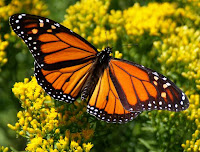
The Monarch butterfly (Danaus plexippus) is a milkweed butterfly (subfamily Danainae), in the family Nymphalidae. It is perhaps the best known of all North American butterflies. Since the 19th century, it has been found in New Zealand, and in Australia since 1871 where it is called the Wanderer. The Monarch butterfly are beautiful, flying insects with large scaly wings. Like all insects, they have six jointed legs, 3 body parts, a pair of antennae, compound eyes, and an exoskeleton. The three body parts are the head, thorax (the chest), and abdomen (the tail end). The four wings and the six legs of the butterfly are attached to the thorax. The thorax contains the muscles that make the legs and wings move.
Monarch

Sunday, May 22, 2011

Lorquin's Admiral


Lorquin's Admiral
The Lorquin's Admiral (Limenitis lorquini) is a large West Coast Limentis species, with a physical resemblance to the California Sister. Both species share some habitats, the Lorquin's habitat is more extensive, spanning coastal areas, stream sides, and on flowers in both valley and mountain terrain.

Common Buckeye


Common Buckeye
The (Common) Buckeye (Junonia coenia) is a butterfly in the family Nymphalidae. It is found in southern Manitoba, Ontario, Quebec, and Nova Scotia and all parts of the United States except the northwest, and is especially common in the south, the California coast, and throughout Central America and Colombia. The sub-species Junonia coenia bergi is endemic to the island of Bermuda.

Saturday, May 21, 2011

Satyr Comma


Satyr Comma
Upperside of Satyr Comma is bright yellow-orange; forewing with two black spots near center of bottom edge; hindwing lacks a dark border, has a black spot in center of wing. Underside is light and dark golden brown, median band relatively straight; hindwing with a silver comma in center.In late afternoon, males perch on tree trunks and low vegetation in woodland openings to watch for females. Eggs are laid singly, in stacks, or in groups on the lower side of nettle leaves.

Friday, May 20, 2011

Mourning Cloak


Mourning CloakMourning Cloaks mate in early Spring. Females lay eggs on a host plant. A host plant is the plant that caterpillars need to eat. Every butterfly has only certain plants it will eat. Mourning Cloak caterpillars eat willow, American Elm, poplar, hackberry, wild rose, and hawthorns. They are most often seen on Black Willow. Eggs are laid in groups. They are pale yellow at first. Then they turn red, then black before they hatch.

Red Admiral


Red Admiral
The Red Admiral (Vanessa atalanta) is a well-known colourful butterfly, found in temperate Europe, Asia and North America. The Red Admiral has a 45–50 mm, wing span. The species is resident only in warmer areas, but migrates north in spring, and sometimes again in autumn. This large butterfly is identified by its striking dark brown, red, and black wing pattern. More specifically, the dark wings possess orange bands that cross the fore wings and on the outer edge of the hind wings; white spots on the dorsal fore wings near the front margin; reddish bars on dorsal surface of all four wings The caterpillar feeds on nettles,

Wednesday, May 18, 2011

American Lady

American LadyThe American Painted Lady or American Lady (Vanessa virginiensis) is a butterfly found throughout North America. Vanessa virginiensis lives in flowery habitats, usually in mountains. The larvae feed on various Asteraceae, especially the cudweeds of genus Gnaphalium. All stages of the life cycle can be found throughout temperate North America as well as Madeira and the Canary Islands. Occasionally individuals can be found as far as south-west Europe.

Twitter Delicious Facebook Digg Stumbleupon Favorites More

 
Bloggerized by Lasantha - Premium Blogger Themes